
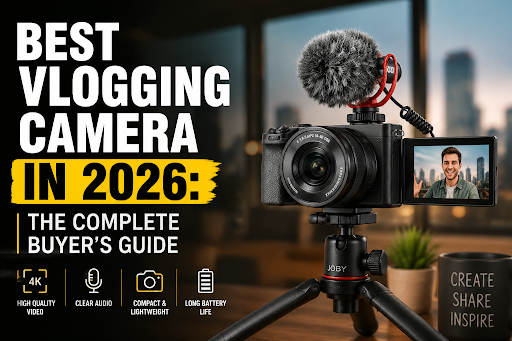
Quick Answer: The best vlogging camera in 2026 depends on your budget and shooting style, but for most creators, a compact mirrorless camera with a flip screen, solid autofocus, and good low-light performance covers nearly every use case. Sony’s ZV-E10 II and the Canon EOS R50 remain top picks for beginners, while the Sony ZV-E1 and Canon EOS R7 lead for advanced creators. If the budget is tight, a modern flagship smartphone paired with a gimbal can genuinely compete with entry-level dedicated cameras.
Key Takeaways
- 📷 Flip screens are non-negotiable for solo vloggers — always check for a fully articulating display before buying.
- 🎙️ Audio quality matters as much as video — built-in mics are rarely enough; plan for an external mic from day one.
- 🔋 Battery life and overheating are the two most common complaints in real-world vlogging use — check user reviews carefully.
- 💡 Sensor size affects low-light performance — APS-C sensors offer the best balance of image quality and compact body size for most vloggers.
- 🎯 4K at 30fps is now the baseline — look for 4K/60fps if you plan to slow down footage or future-proof your content.
- 💰 Budget tiers matter — under $500, $500–$1,200, and $1,200+ each offer meaningfully different capabilities.
- 🤳 Smartphone cameras have closed the gap — for travel vloggers who prioritize portability, a phone like the Apple iPhone 18 Pro Max is a serious contender.
- 🎬 Stabilization type matters — in-body image stabilization (IBIS) beats electronic stabilization for quality; a gimbal adds another layer.
- ⚖️ Weight and form factor affect how often you actually use the camera — the best camera is the one you carry.
- 🔌 USB-C charging is now expected — avoid cameras that still rely on proprietary chargers.
What Makes a Camera the Best Vlogging Camera?
The best vlogging camera must solve three practical problems at once: capturing clean video in variable lighting, recording usable audio, and staying portable enough to use consistently.
Unlike filmmaking cameras built for controlled sets, a vlogging camera lives in the real world — in bags, on selfie sticks, and in front of faces in coffee shops. That context changes everything about what specs actually matter.
Core features every vlogging camera should have:
- Fully articulating or flip-out touchscreen — essential for framing yourself when shooting solo
- Fast, reliable autofocus — face and eye tracking saves footage that would otherwise be blurry and unusable
- 4K video recording — at minimum 4K/30fps; 4K/60fps is better for flexibility in editing
- Good low-light performance — most vlogging happens in imperfect lighting; a larger sensor helps significantly
- External microphone input — a 3.5mm jack or USB-C audio input opens up far better audio options
- Compact, lightweight body — anything over 700g with a lens becomes a burden on long shooting days
- USB-C charging — charge from a power bank while traveling; this is a practical necessity in 2026
Features that sound important but rarely matter for vloggers:
- RAW photo shooting (most vloggers shoot video only)
- Weather sealing (useful but rarely decisive)
- Dual card slots (overkill for solo content creators), see more


